The site mind · Offices

Robots in your office. A site mind that knows the place.

The short answer

What can an office robot do today? In supervised tests, the site mind runs an off-the-shelf robot across a floor with a member of the facilities team; it comes when called and, when asked, sends a photo of what it sees. It does not patrol on its own or replace security. Founding-site pilots run 30 days, after a free building scan. A monthly fee per robot; pricing on request.

Today
In supervised tests, the site mind runs an off-the-shelf robot through shared areas with a person beside it: it comes when called, learns rooms by name and says what it sees with a photo when asked. Three ways to stop it.
Not yet
After-hours patrols a robot walks on its own. Carrying or handing over things. Opening doors, calling lifts or passing badge readers. It does not replace security staff, alarms or emergency response.
How a pilot works
Tell us about your office for free. On a short call we agree the first task and the areas in scope, in writing, before anything is charged. We start on one approved floor with an operator present.
How long
We're mapping buildings now, for founding sites in the US and Asia. Pilots run 30 days for up to 2 robots, with the price agreed up front. At day 30 you decide whether to continue onto the term, and if you do, the pilot month counts toward it.
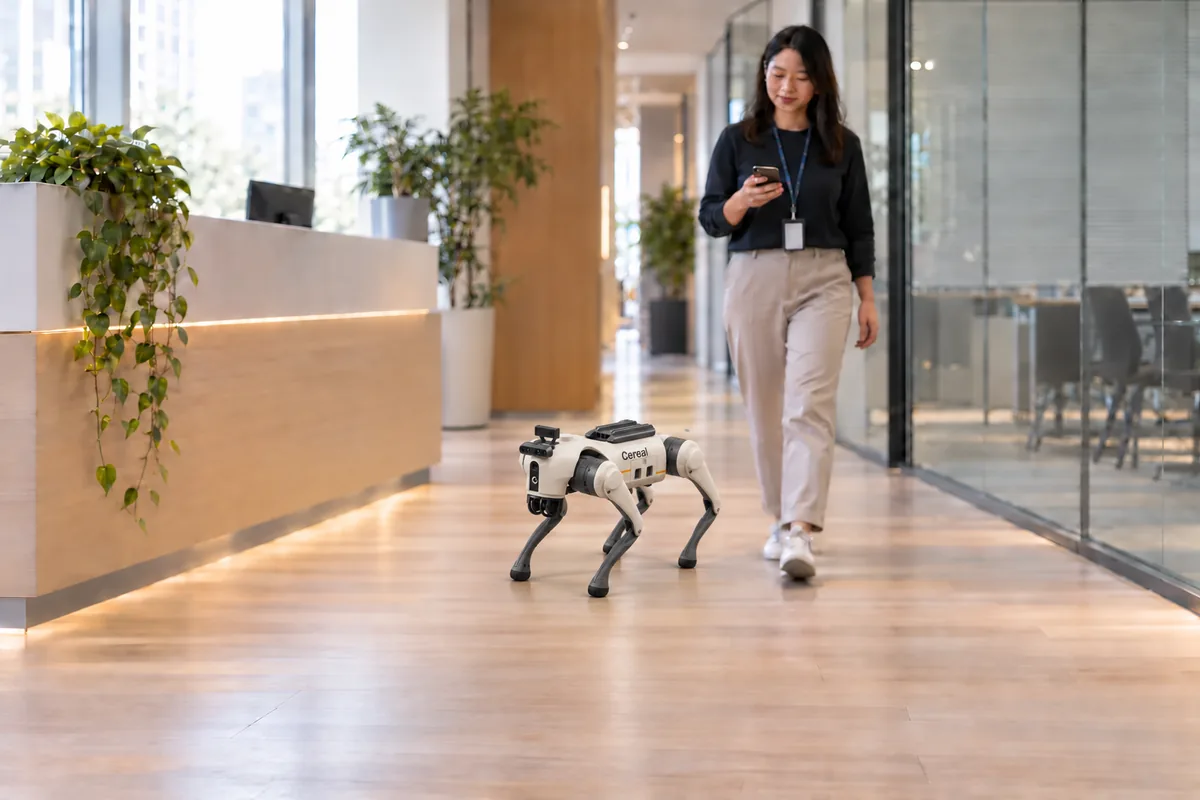
A four-legged robot walking along an office corridor beside reception, with a staff member a few steps behind it

For workplace, facilities and office operations teams

What could a robot do in my office?

An office robot should understand more than a route. It should know the meeting rooms, who may ask it to act, and when to get a person involved. Cereal's site mind keeps that context for every robot in the building, from any maker: one live map, one record and who may command what.

Start with a small, useful route: a robot accompanies a facilities operator through shared areas, and the site mind describes what it can see when asked. Then evaluate repeatable room checks and the information your team needs afterward. Office workflows need their own site assessment and supervised validation.

01 / A workflow to evaluate

A facilities walk, with context

Use ordinary room names instead of teaching everyone a control interface. A pilot can test a short route through reception, a meeting room and a shared corridor. Agree which observations matter and what should happen if the route is blocked.

02 / A workflow to evaluate

Someone to ask

Ask in plain words for an observation or a follow-up. The site mind checks who is asking and what they may command before any robot moves. Permission to see a result is separate from permission to move a robot.

03 / A workflow to evaluate

Checks your team can review

Evaluate whether a robot's observations make handovers easier: what room was checked, when it was checked and whether the task completed. A failed or interrupted check must remain visible. Automatic after-hours patrols and reliable change detection are pilot objectives, not promises of unattended coverage.

Pricing

A monthly fee per robot, and what a pilot covers.

What an office pilot includes
OptionWhat it covers
The site mind, per robotA monthly fee for each robot the site mind runs: the live map, places by name, who may command what, the record the site owns, software updates and remote support
The robotsRobots the site already has, or off-the-shelf robots from their makers, bought or leased from the maker. Cereal does not build or sell robots
SetupNo setup fee for founding sites. We map your site with your team and connect the robots it will run

Cereal charges a monthly fee per robot the site mind runs. Cereal does not sell robots. Pricing on request: talk to us at hello@cereal.bot.

Talk to us about pricing →

After hours

Patrols on its own are next, not today.

Today a person walks with the robot. Patrols a robot walks on its own, from a list of places you name, are planned, with a photo at each stop and an alert to a person when something needs attention. We will test them with a person present before we say they work.

Even then, it is another pair of eyes for your security or facilities team, not a replacement for them.

Works with robots from many makers

A job must fit its robot.

Cereal does not build or sell robots. The site mind runs the robots a site already has, or off-the-shelf robots it picks from their makers, on one live map, with one record the site owns and one set of rules for who may command what. Site context is designed to outlast any one robot. A new robot still needs a supported integration, localization, permission review and validation of its skills. In a real run, one voice request ran a robot dog and robot arms from two different makers on one job, taking turns.

Watch the two-robot run → Robots from different makers on one site →
Before a pilot

Make it fit the place.

Start small enough to learn what works. Expand only after the team and the site owner review the results.

Read about permissions and privacy →

People and private spaces

Decide which shared areas are in scope. Keep meeting rooms in use, personal workspaces and sensitive information out of camera access unless explicitly agreed. Set who can request actions and who can view the results.

An actual route

Review thresholds, glass, loose cables, doors, stairs and lift access. A robot's ability to walk or roll does not establish that it can safely use every part of your building. Begin on one approved floor with an operator present.

Power, connectivity and support

Identify charging space, network coverage, an on-site supervisor and a stop procedure. The site mind uses internet connectivity today. Door systems, lifts and unattended charging need separate integration and testing.

How a pilot works

A pilot in four steps.

  1. 01

    Tell us about it

    Write to us about your office, the robots you run or plan to run, and the checks you want to improve. It is free and commits you to nothing.

  2. 02

    A free building scan

    We scan your office with your team, free, and you keep the map. If it fits, we agree the first task on a short call, using only what works today, and put the scope and start date in writing before anything is charged.

  3. 03

    Set it up

    We set it up with you on one approved floor, with an operator present and a stop procedure everyone knows.

  4. 04

    Measure and decide

    Over the 30 days we review what it found, how often a person stepped in and what your team used. At day 30 you decide whether to continue onto the term.

Measure something useful

Agree what success means.

A pilot should answer a real question for you. Record the starting point, test the agreed workflow and review where it helped or needed intervention.

  • 01Useful observations on the agreed route
  • 02Time saved preparing a facilities handover
  • 03How often a person must intervene
  • 04Clear results for completed, refused and interrupted requests
Questions before you join

The practical details.

Is this an office security robot?

You can discuss an inspection or patrol pilot with us. Patrols a robot walks on its own are planned, not available today; today the site mind tells you what a robot sees when you ask. Cereal is not offered as a replacement for a security team, alarm system or emergency response service. The site owner defines the workflow and the person responsible for responding.

Can it deliver coffee or carry supplies?

Only with a robot built for carrying. Cereal does not build robots; running delivery robots from their makers on the same map and record is planned. Carrying and handover depend on the specific robot, its integration and tested skills.

Can it work in an occupied office?

That is something to establish during a site assessment. We agree the route, speed, operating hours, camera boundaries and supervision, then test in controlled conditions before expanding access.

What does an office robot cost?

Cereal charges a monthly fee per robot the site mind runs. Cereal does not sell robots. Pricing is agreed for each founding site; setup, supported workflows, support, recording and retention requirements affect the proposal. Talking to us is free and does not place an order.

Can it do after-hours patrols?

Not on its own yet. Today a person walks with the robot and asks for a look or a photo where it matters. Patrols a robot walks on its own, from a list of places you name, are planned, and we test them with a person present before we offer them.

Can it use lifts, doors and badge readers?

A robot can follow a person into a lift. The site mind does not call a lift, open a door or pass a badge reader today. Lifts, doors and access control are separate integrations that we test building by building; until then, staff handle them.

Who can see what it sees?

Only people you allow. Watching never gives control, every link you share expires within an hour, and you can end a link at any time. We agree which areas are in scope and keep personal workspaces and meeting rooms in use out of view.

Where are pilots?

We're mapping buildings now, for founding sites in the US and Asia.