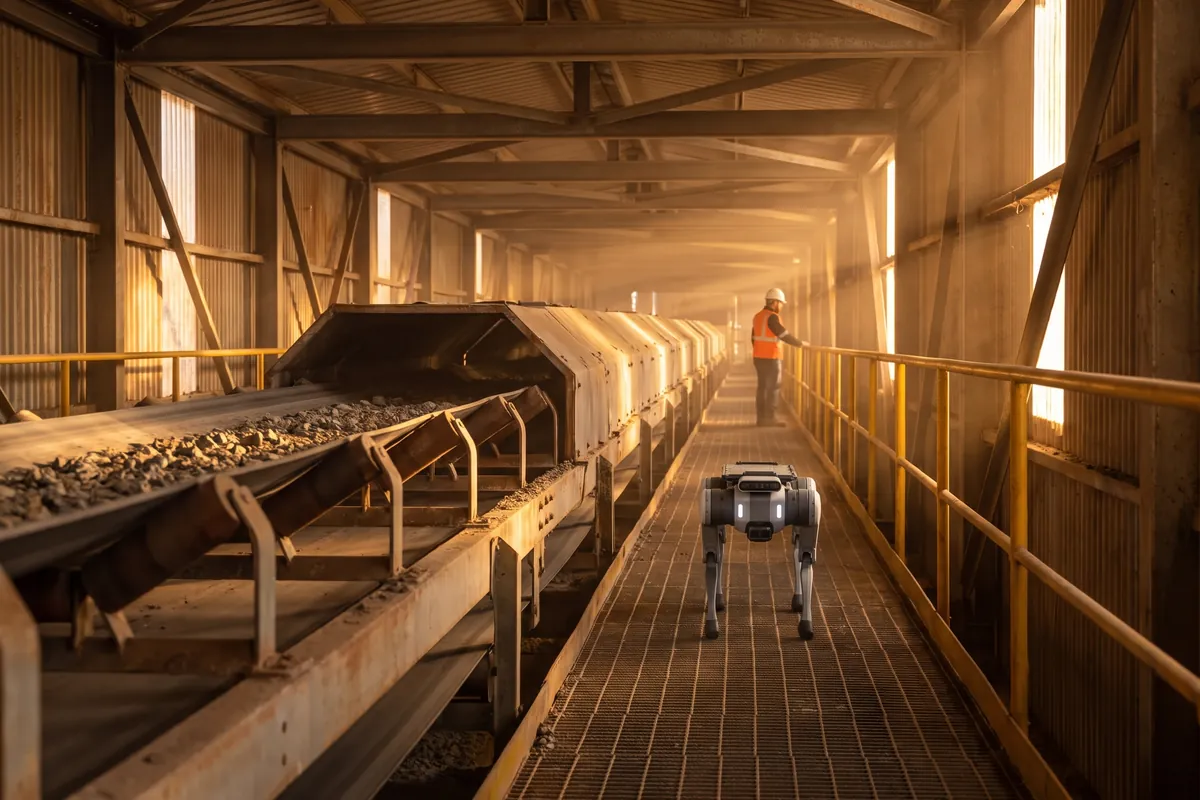
Robots at your mine. Eyes where people shouldn't linger.
Mines send people on long inspection rounds through plants, conveyors and galleries, often in heat, dust, gas or noise. Robots from different makers are starting to take some of those rounds, each with its own app and map. Cereal's site mind puts them on one live map of the surface facilities and the galleries where robots are allowed, under one set of permissions, with one record the mine owns.
For mine operations, maintenance, processing plant and HSE teams
Where does a robot fit at a mine?
Start with rounds people walk today in places they would rather not linger: a plant floor, a conveyor gallery, a pump station. A robot walks the agreed route, photographs the same points and reads visible gauges when asked, so a person sees the result without making the trip. Underground work, gassy areas and active faces need robots rated for them and the mine's own approvals.
01 / A workflow to evaluate
Inspection rounds in hard areas
Photograph the same points along a conveyor, in a pump station or around crushers each round: spillage, damaged guards, standing water, visible wear. Gas or temperature readings need the maker's sensors and validation on your site.
02 / A workflow to evaluate
Perimeter and security checks
Walk fences, gates and stores at the surface with a security officer and keep a timed photo of each stop. Patrols a robot walks on its own are planned, not available today.
03 / A workflow to evaluate
Remote checks
A supervisor in the control room asks in plain words for a look at a place on the map, and a robot that is allowed there goes and shows it, with a person supervising.
Works with robots from many makers
A job must fit its robot.
Cereal does not build or sell robots. The site mind runs the robots a site already has, or off-the-shelf robots it picks from their makers, on one live map, with one record the site owns and one set of rules for who may command what. Site context is designed to outlast any one robot. A new robot still needs a supported integration, localization, permission review and validation of its skills. In a real run, one voice request ran a robot dog and robot arms from two different makers on one job, taking turns.
Gas, dust and explosive atmospheres need robots rated for them by their makers, checked for the exact model and area. Unrated robots stay out: those areas are no-go zones on the map. Cereal does not claim any rating.
No-signal zones, dust and water
Map where Wi-Fi or private LTE reaches. Check the maker's ratings for dust, water, heat and slopes, and plan charging and cleaning.
Permits and people
Each route follows the mine's permits, isolation and lockout rules like any other task. Agree who supervises, who can stop the robot and how it is recovered if it stalls in a gallery.
Measure something useful
Agree what success means.
A pilot should answer a real question for you. Record the starting point, test the agreed workflow and review where it helped or needed intervention.
01Rounds completed with usable photos and readings
02Fewer trips by people into hot, dusty or gassy areas
03Exceptions reaching maintenance with location and time
04Recoveries per round, and why they were needed
Questions before you join
The practical details.
Can it work underground?
Only in galleries where the mine allows robots, with a robot rated for the conditions and coverage planned along the route. Pilots start at the surface, in plants and conveyor galleries, with a person present.
What happens where there is no signal?
A robot out of coverage cannot take requests or send photos until it is back in range, so routes and recovery points follow your coverage. Running the site mind without the internet is planned.
Does it replace a person's inspection?
No. It takes on some of the walking and looking. A person still decides what is a fault, signs off the inspections your regulator requires and responds to anything found.
How do we start, and how is it priced?
Tell us about your site, the robots you run or plan to run and the round you want to improve. We scope setup, support and any integrations with you. Cereal charges a monthly fee per robot the site mind runs. Cereal does not sell robots; pricing and timing are agreed before any commitment or charge.