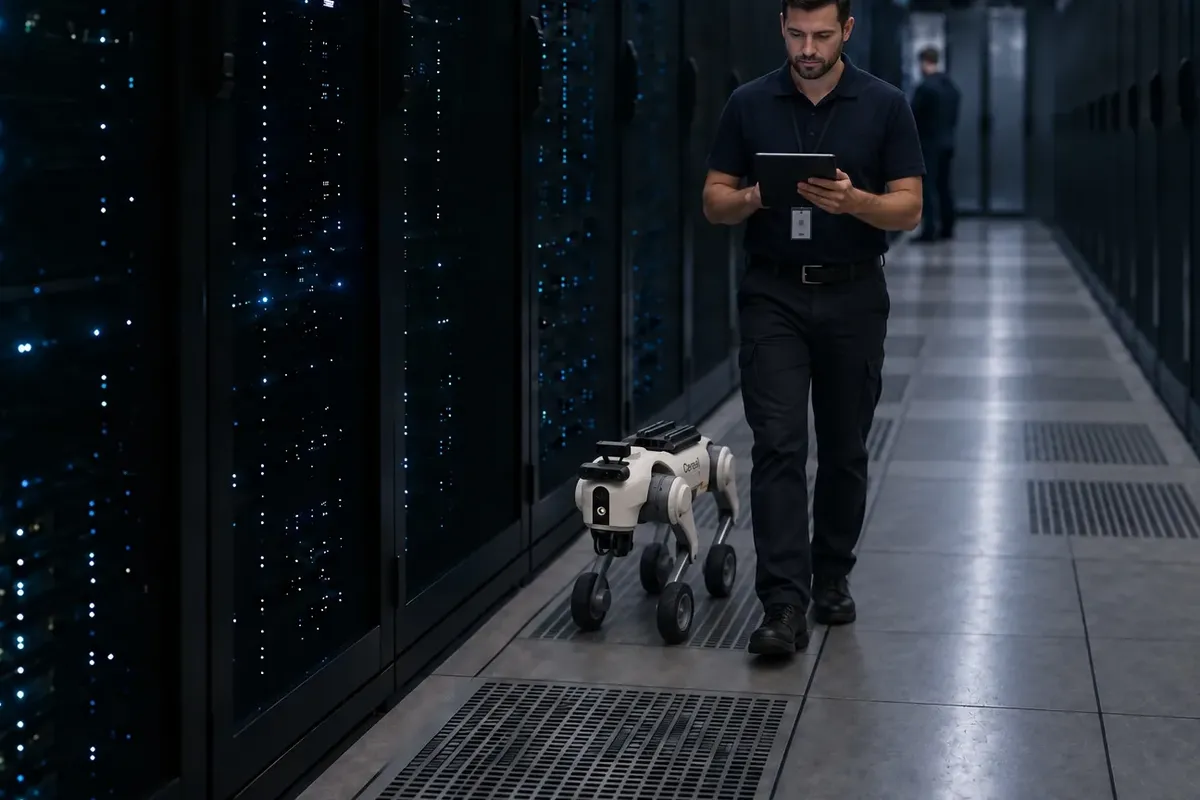
Robots in your data hall. Every round on the record.
Data halls are checked around the clock: rack lights, hot and cold aisles, doors and cages. The rounds repeat, the access rules are strict and every visit has to be accounted for. Cereal's site mind puts robots from different makers on one live map of halls, aisles and cages, under the same kind of access rules as people, with one record the operator owns.
For data center operations, critical facilities and security teams
What could a robot do in a data center?
Start with rounds your technicians already walk: a supervised pass down agreed aisles that photographs rack status lights, an open cabinet door or something left in the aisle. Robots stay out of customer cages unless the customer allows it, and they never touch equipment.
01 / A workflow to evaluate
Rack and thermal rounds
Photograph the same points in agreed aisles each round: status lights, open cabinet doors, floor tiles out of place. With a thermal camera from the robot's maker, a pilot tests whether hot spots show up usefully. The readings support your monitoring; they do not replace it.
02 / A workflow to evaluate
After-hours security patrols
A security officer walks the perimeter corridors, the loading dock and the hall doors with the robot and gets a timed photo at each stop. Patrols a robot walks on its own are planned, not available today. The robot does not respond to alarms or intruders, and it does not replace officers, cameras or access control.
03 / A workflow to evaluate
Parts to the cage
Moving spares from the store to a cage needs a robot built for carrying, from its maker. Running it on the same map, with the same cage permissions as a technician, is planned and tested before it is offered.
Works with robots from many makers
A job must fit its robot.
Cereal does not build or sell robots. The site mind runs the robots a site already has, or off-the-shelf robots it picks from their makers, on one live map, with one record the site owns and one set of rules for who may command what. Site context is designed to outlast any one robot. A new robot still needs a supported integration, localization, permission review and validation of its skills. In a real run, one voice request ran a robot dog and robot arms from two different makers on one job, taking turns.
A robot gets access rules like a person's: which halls, which aisles, which hours, and which cages, if any, with the customer's written permission. Doors, mantraps and badge readers stay with staff until any integration is tested.
Cameras and customers
No camera views into customer cages unless that customer allows it. Agree what the robot may photograph in shared aisles, who can view it, how long it is kept and what customers are told.
ESD, cleanliness and the floor
Check the robot against your ESD and cleanliness rules, raised floors and ramps. Agree where it charges and battery rules your fire safety team accepts.
Measure something useful
Agree what success means.
A pilot should answer a real question for you. Record the starting point, test the agreed workflow and review where it helped or needed intervention.
01Rounds completed with usable photos and readings
02Exceptions reaching the right technician quickly
03Technician minutes saved on routine rounds
04No access or customer-privacy breaches
Questions before you join
The practical details.
Will it film customer equipment?
Not inside customer cages, unless that customer agrees in writing. In shared aisles, only people the operator allows can open the robot's live view, and every link you share expires within an hour.
Does it replace our monitoring systems?
No. Your monitoring systems stay the source of truth. A robot adds eyes on the floor and a photo record; connecting its readings to them is separate scope.
Can it touch or move equipment?
No. It does not open cabinets, press buttons or move servers. Carrying parts needs a robot built for it, and a person handles every installation.
How do we start, and how is it priced?
Tell us about your halls, the robots you run or plan to run and the round you want to improve. We scope setup, support and any integrations with you. Cereal charges a monthly fee per robot the site mind runs. Cereal does not sell robots; pricing and timing are agreed before any commitment or charge.