Night walks of guest floors
Walk an agreed corridor route and report what is visible: room service trays, a propped fire door, a spill or a blocked exit. The duty manager decides what to do, and each walk keeps the time, place and result.
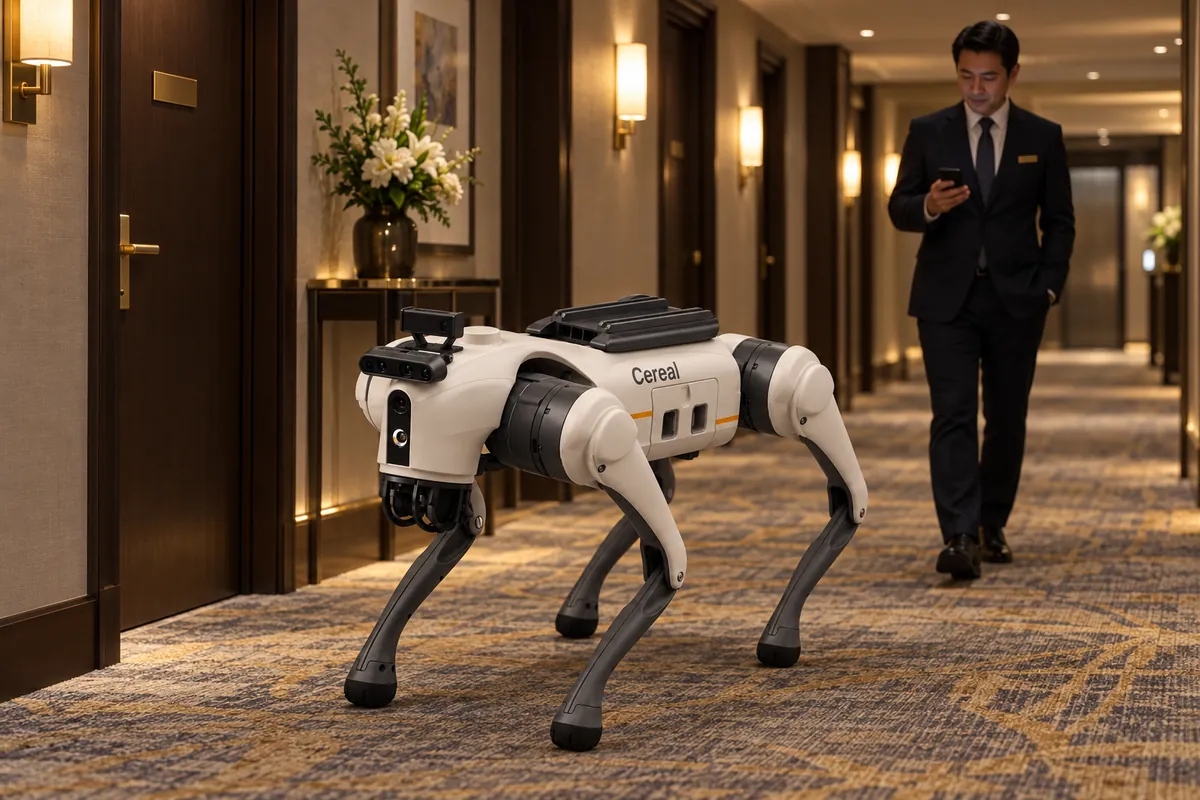
What can a hotel robot do today? In supervised tests, the site mind runs an off-the-shelf robot along a corridor with a member of the team and, when asked, sends a photo of what it sees, such as a tray left out or a propped fire door. Delivery is planned. Founding-site pilots run 30 days, after a free building scan. A monthly fee per robot; pricing on request.
For hotel general managers, operations and engineering teams
Hotel teams walk the same corridors many times a night, and many hotels already run delivery or cleaning robots from different makers. Cereal's site mind puts them on one live map and one record, reports what needs a person and keeps the record for the morning handover. The hotel decides where each robot may go and who sees what.
Start with checks your team already does: a supervised night walk of one guest floor or back-of-house corridor, reporting trays left out, a propped fire door or a spill to the duty manager. Running delivery robots from their makers on the same map is planned, not available yet. Hotel workflows need their own site survey and validation.
Walk an agreed corridor route and report what is visible: room service trays, a propped fire door, a spill or a blocked exit. The duty manager decides what to do, and each walk keeps the time, place and result.
Check service corridors, linen stores and plant-room doors on the engineering team's list, and record which were checked and which could not be reached. Specialist sensors such as temperature or leak detection are separate scope.
Staff can ask about the last walk or a particular floor in plain words. Answering guests through a robot needs agreed wording, languages, quiet-hour rules and privacy, and is tested before it is offered.
| Option | What it covers |
|---|---|
| The site mind, per robot | A monthly fee for each robot the site mind runs: the live map, places by name, who may command what, the record the site owns, software updates and remote support |
| The robots | Robots the site already has, or off-the-shelf robots from their makers, bought or leased from the maker. Cereal does not build or sell robots |
| Setup | No setup fee for founding sites. We map your site with your team and connect the robots it will run |
Cereal charges a monthly fee per robot the site mind runs. Cereal does not sell robots. Pricing on request: talk to us at hello@cereal.bot.
Cereal does not build delivery robots. The site mind is planned to run delivery robots from their makers on the same map, under the same permissions and record, and we test each delivery workflow before we offer it.
Whichever robot a hotel chooses, a delivery robot needs these before it saves anyone a trip:
Count the routine walks or deliveries it would take on in a night. Multiply by the staff minutes each one takes today and by your loaded hourly cost, then subtract the monthly fee.
Be honest about today: a person walks with the robot, so an early pilot measures what it found and how your team used the record, not staff minutes saved. Minutes saved grow when patrols a robot walks on its own arrive, which is planned.
Cereal does not build or sell robots. The site mind runs the robots a site already has, or off-the-shelf robots it picks from their makers, on one live map, with one record the site owns and one set of rules for who may command what. Site context is designed to outlast any one robot. A new robot still needs a supported integration, localization, permission review and validation of its skills. In a real run, one voice request ran a robot dog and robot arms from two different makers on one job, taking turns.
Watch the two-robot run → Robots from different makers on one site →Start small enough to learn what works. Expand only after the team and the site owner review the results.
Read about permissions and privacy →No camera views into guest rooms, ever. Agree which corridors are in scope, quiet hours, what is recorded and who can view it, and tell guests how the robot is used.
Survey carpets, thresholds, fire doors, lifts and the routes housekeeping carts use. Start on one approved floor, with lifts and doors handled by staff until any integration is tested.
Name the duty manager who receives reports and can stop the robot. Agree charging space, connectivity and what happens when a walk is interrupted.
Write to us about your hotel, the robots you run or plan to run, and the checks you want to improve. It is free and commits you to nothing.
We scan your hotel with your team, free, and you keep the map. If it fits, we agree the first task on a short call, using only what works today, and put the scope and start date in writing before anything is charged.
We set it up with you on one approved floor, with the duty manager reachable and a stop procedure everyone knows.
Over the 30 days we review what it found, how often a person stepped in and what your team used. At day 30 you decide whether to continue onto the term.
A pilot should answer a real question for you. Record the starting point, test the agreed workflow and review where it helped or needed intervention.
Cereal charges a monthly fee per robot the site mind runs. Cereal does not sell robots. Tell us about your hotel, the robots you run and the checks you want to improve. We scope setup, support and any integrations with you. Pricing and timing are agreed before any commitment or charge.
No. Cereal is software. The hotel keeps the robots it has, or buys or leases them from their makers, and pays Cereal a monthly fee per robot the site mind runs.
Count the routine walks or deliveries it would take on in a night, multiply by the staff minutes each takes today and your loaded hourly cost, and subtract the monthly fees. Today a person walks with the robot, so an early pilot measures what it found and what your team used before it measures minutes saved.
Only with a delivery robot from its maker. Running delivery robots on the same map and record is planned, and each delivery workflow is tested before it is offered.
No camera views into guest rooms, ever. In corridors a robot takes a photo when a member of your team asks for one, and only people the hotel allows can open its live view; every link expires within an hour. We agree the corridors in scope, quiet hours, what is kept and how guests are told.
A robot can follow a member of your team into a lift. The site mind does not call a lift, open a door or pass a card reader today. Lift and door integration is separate work that we test building by building; until then, staff handle lifts and doors.
Night walks are agreed with the hotel, including quiet hours, walking speed and which floors are in scope. The pilot measures guest feedback alongside the operational results.
We're mapping buildings now, for founding sites in the US and Asia.
No. It reports what it sees to the person who asked, such as the duty manager, on agreed routes. It does not replace security staff, alarms or emergency procedures.
Tell us the robots you run or plan to run. Suitability, supported tasks, timing, pricing and support are agreed before anything is charged.