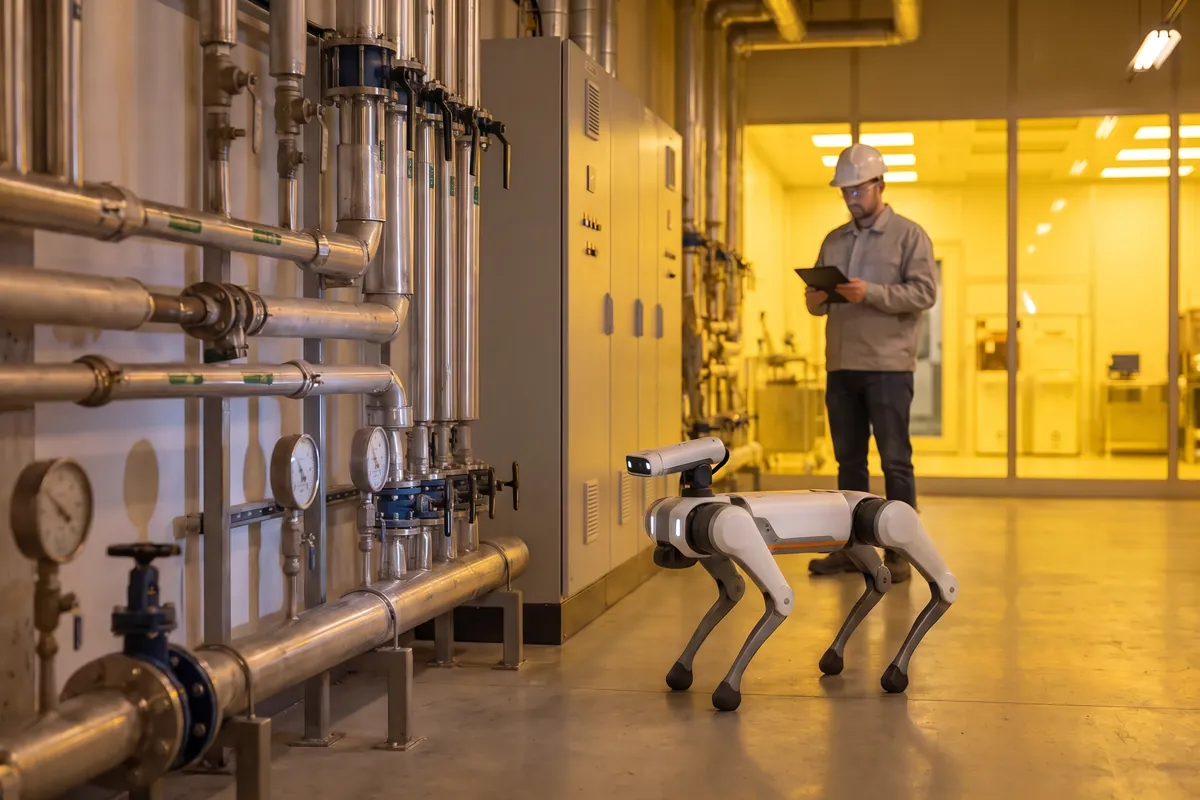
A fab or plant moves parts, reads gauges and checks rooms around the clock, in support corridors, warehouses and utility areas. Overhead transport moves the wafers; new robots arrive from different makers, each with its own app. Cereal's site mind puts them on one live map that carries the cleanliness classes, gowning zones and no-go areas the plant already has, with one record the plant owns.
For fab facilities, manufacturing operations, EHS and security teams
Where do robots fit in a fab or plant?
Start outside the clean room: support corridors, warehouses and utility areas, where a robot can carry parts or walk a gauge-reading round. Inside the clean-room tool bays, wafer handling stays with the tools and the automated material handling system (AMHS) built for it; a robot goes there only if it meets that area's class and the fab approves it. Hazmat areas are no-go zones on the map.
01 / A workflow to evaluate
Material and parts transport
Carry spares, consumables and kits from a warehouse to the edge of a gowning zone, with a robot built for carrying from its maker. Running transport robots on the same map is planned and tested route by route. The hand-off at the gowning boundary stays with people.
02 / A workflow to evaluate
Inspection and gauge-reading rounds
Photograph the same gauges, panels and doors along agreed utility corridors each round, and flag readings for a person to confirm. It does not replace your facility monitoring or alarms.
03 / A workflow to evaluate
Security rounds
A security officer walks the perimeter corridors, the docks and the warehouse with the robot and gets a timed photo at each stop. Patrols a robot walks on its own are planned, not available today.
Works with robots from many makers
A job must fit its robot.
Cereal does not build or sell robots. The site mind runs the robots a site already has, or off-the-shelf robots it picks from their makers, on one live map, with one record the site owns and one set of rules for who may command what. Site context is designed to outlast any one robot. A new robot still needs a supported integration, localization, permission review and validation of its skills. In a real run, one voice request ran a robot dog and robot arms from two different makers on one job, taking turns.
Map each area's cleanliness class and gowning zone. A robot that does not meet an area's class stays out, and its wheels, materials and charging must suit every area it enters.
Sharing the floor with AMHS and vehicles
Overhead transport, AGVs, forklifts and carts already share the plant. Agree crossings, waiting points and right of way. Start on one route separated from moving equipment.
Hazmat and no-go zones
Chemical stores, gas cabinets, bulk gas yards and hazardous areas are no-go zones on the map unless a robot is rated for them by its maker and approved. Your EHS team approves every route before it is walked.
Measure something useful
Agree what success means.
A pilot should answer a real question for you. Record the starting point, test the agreed workflow and review where it helped or needed intervention.
01Rounds completed with readable gauges and photos
02Out-of-range readings reaching the right person quickly
03Interventions per round, and why they happened
04No entries into no-go or gowning zones
Questions before you join
The practical details.
Can a robot work inside the clean room?
Only if the robot meets that area's cleanliness class and the fab approves it. Pilots start in support areas outside the clean room.
Does it replace our AMHS?
No. AMHS moves wafers between tools. Robots in support areas carry other things, such as spares and consumables, and the map keeps them out of AMHS zones.
Can it read gauges and meters?
It reads a visible gauge or display when asked, on an agreed route. A pilot measures how often the reading is right in your lighting, and a person confirms anything out of range.
How do we start, and how is it priced?
Tell us about your plant, the robots you run or plan to run and the round you want to improve. We scope setup, support and any integrations with you. Cereal charges a monthly fee per robot the site mind runs. Cereal does not sell robots; pricing and timing are agreed before any commitment or charge.