The scientific foundations of general embodied intelligence.
Cereal is a research effort first: portable AI minds that learn in simulation, transfer across bodies, and compound through real-world deployment. This is the agenda, and the live system already running underneath it.
The simulator isn't a training ground. It's the live world.
Real sim-to-real robotics runs the world loop as the always-on, authoritative model of the space, like a video game. Learned world models predict the outcome; the digital twin verifies the plan before the body moves; the physical robot executes against it. The game state is canonical; the hardware renders it into the world.
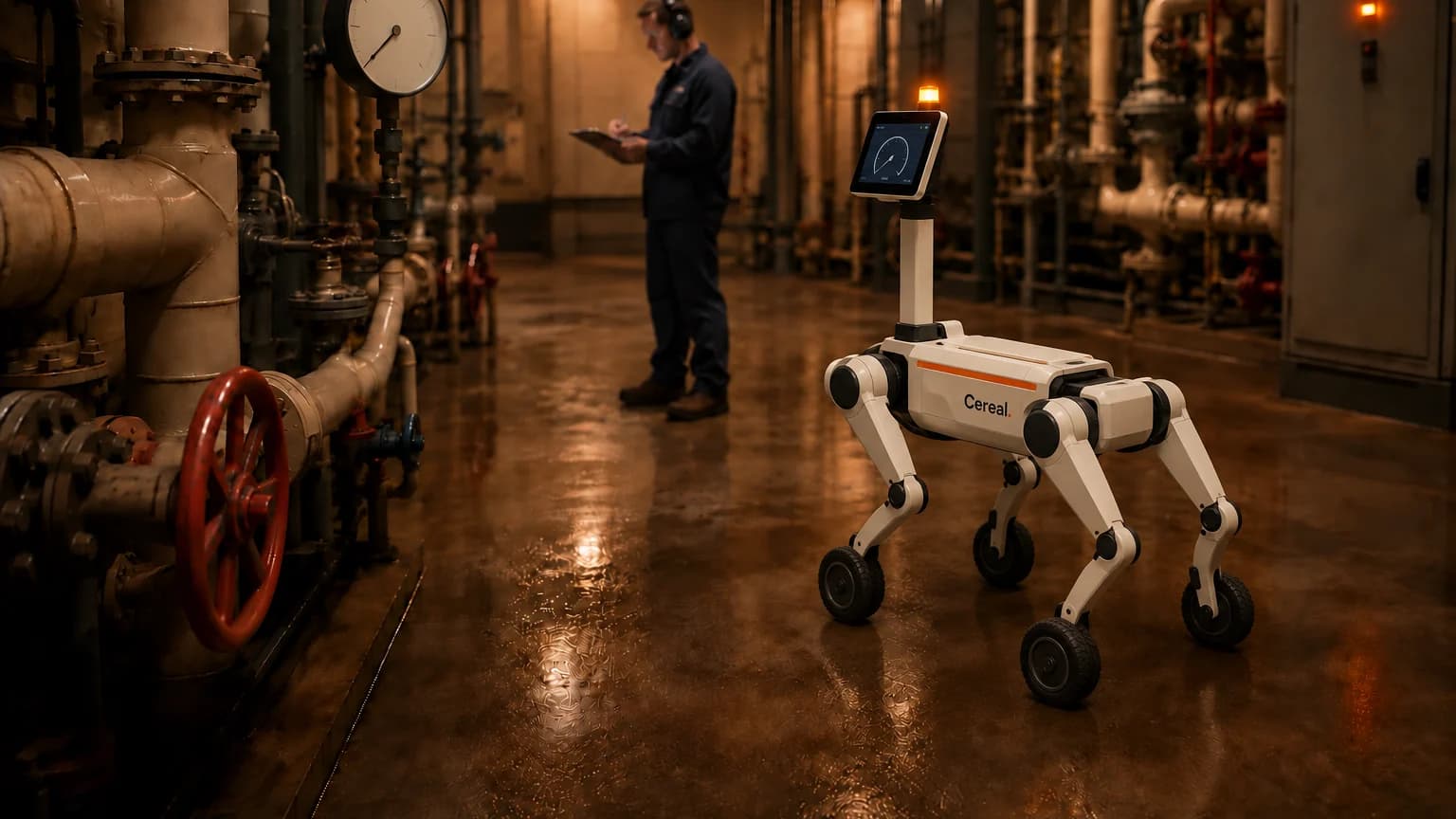
Plan in the twin. Execute on the body.
Four problems worth owning.
Models that connect vision, language, memory, planning, and action. We build the runtime that composes and improves them, rather than betting the company on a single end-to-end policy.
Persistent, queryable understanding of buildings, objects, people, and routines, so a robot reasons over a live world model instead of raw frames. Where Cole's memory becomes a differentiator.
The simulator as the always-on, authoritative world model. Procedural sites, synthetic failure, automatic curriculum, and sim-to-real measurement, so learning does not require a million real robots.
A runtime abstraction between intent and morphology. Write the intelligence once; run it across arms, mobile bases, and humanoids. One mind, any body, made technical. v1.1 of the runtime is public, 49 tests green.
The questions we're taking on.
How should robots build and maintain a persistent world model?
How should embodied memory work across a site, over time?
How should uncertainty be quantified before a robot acts?
How do policies transfer across embodiments with minimal retraining?
How should a fleet learn continuously without regressing?
How should simulation generate its own curriculum?
We publish as the work lands, not before.
The reports we intend to put out as the results come in. An agenda, not a claim of finished science.
ResultUpdate, September 2026: v1.1 of the runtime is public, 49 tests green, and the arms are on the bench. Read the build update
A benchmark for site sim-to-real transfer.
Tasks, metrics, and reality-gap measurement for useful robots in buildings.
An embodiment contract for portable robot intelligence.
How one mind and runtime map onto multiple bodies: manifests, bindings, safe refusal, and the attested trail.
Human-in-the-loop supervision for safe robots in critical facilities.
Uncertainty gates, remote assist, auditability, and safe fallback.
Cole as the planning and memory layer for embodied agents.
Connecting a deployed cognitive substrate to robotics.
The founders already invented the hard part.
Named inventors on the foundational simulation-driven robotics patents, the exact sim-to-real approach Cereal runs on, from the teams that built modern robotics. Prior world-model work: RetinaGAN (Everyday Robots), HitNet with Google Brain, scene-transformer models (Stack AV).
Simulation-driven control of real robots.
Founder-authored. The seed of the sim-to-real world loop Cereal is built on. The family is active: a continuation granted November 2025 under Google DeepMind. Read the deep dive
Simulation, imitation learning, fleet-scale sim.
Plus international filings: re-simulating recorded episodes, noise injection for robustness, mixed-fidelity training, and multi-robot virtual environments.
From the teams that built modern robotics.
Founders from these labs, not newcomers learning the field.
Inventor credentials reflect work at prior employers; the patents are assigned to those employers.