A frontier model meets a clapperboard
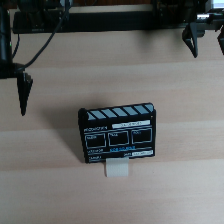
A small repository appeared on GitHub this week, clapboardbench, and it is worth twenty minutes of any roboticist's attention. Someone put a film clapperboard in front of a real bimanual arm rig and let frontier vision-language models drive it turn by turn, one motion per model call. Then they published the entire nervous system of the experiment: every camera frame the model was sent, its reasoning note before each move, every tool call, the raw wire traffic, and video of every run. The task is one verb. Lift the clapper stick, then let go so it snaps shut with a clap.
The scores: the robotics-specialized model under test went zero for five. The strongest general model went two for seven, and its successes took five and seventeen minutes. One failed run lasted twenty-nine minutes and over twelve hundred motions. A human operator judged every run live.
What this actually measures
It would be easy to read this as evidence that the models are weak, and that reading would be wrong. These are the most capable machine minds ever built, and pointed at a clapperboard they can see the stick, describe the stick, reason about the stick, and still spend a quarter of an hour failing to snap it. What the traces measure is not model quality. It is the distance between reasoning about a scene and acting dependably in one, with nothing in between: no skill library, no memory of the last attempt, no rehearsal, no notion of when to stop and ask. The naive architecture, frontier model straight onto metal, is now publicly characterized, and the characterization is generous to no one.
The quiet result inside the result
The run table holds a second finding. The model purpose-built for robotics scored below the general-purpose one. Five runs is not a verdict, and we will not pretend it is. But it rhymes with how every prior platform settled: capability concentrates in general models, and the differentiation that lasts gets built in the layer above them, where skills are certified, memory persists, and outcomes are checked. If specializing the brain below that layer paid, this table is where it would have shown up first.
The format is the real contribution
Here is what we admire most: the traces are complete. Every frame the model saw, every decision it made, every failure, judged by a named standard, browsable by anyone. That is what a claim about a robot working should be required to look like, and it is the bar we hold our own field evidence to: certified outcomes and attested actions, replayable, so the claim can be checked rather than believed. A machine earns its place around people the same way. Not by a highlight reel. By a record.
The models will get better, quickly, and we are glad; motor capability is our supply chain, and every improvement arrives in our stack the same day. The clapperboard will get snapped. The distance the traces expose, between a mind that can reason and a machine a family can rely on, does not close with a better model. It closes with the layer built for exactly that distance. That is the part we are building.